
A Nassim Nicolas Taleb debunking argument
Why you should not trust this man


Nassim Taleb. The Black Swan, Antifragile, and Skin in the Game guy. A man who makes his career by tearing down insecure and thin-skinned empty intellectuals… also manages to be the most insecure and thin-skinned intellectual I have ever read.
As Taleb reminds us, a true maschismo mafia don/Brooklynite bodyguard/Roman emperor need not thunder and storm against his enemies. Powerful people who have things worth saying say them quietly and bluntly, and the world must lean in to listen to them speak. The more you rant and rave, the more you out yourself as a man of “cheap tawk.” When I read Taleb’s website and his curated list of “Smear Artists,” I do not get the impression of a balanced and self-possessed inscalfibile.
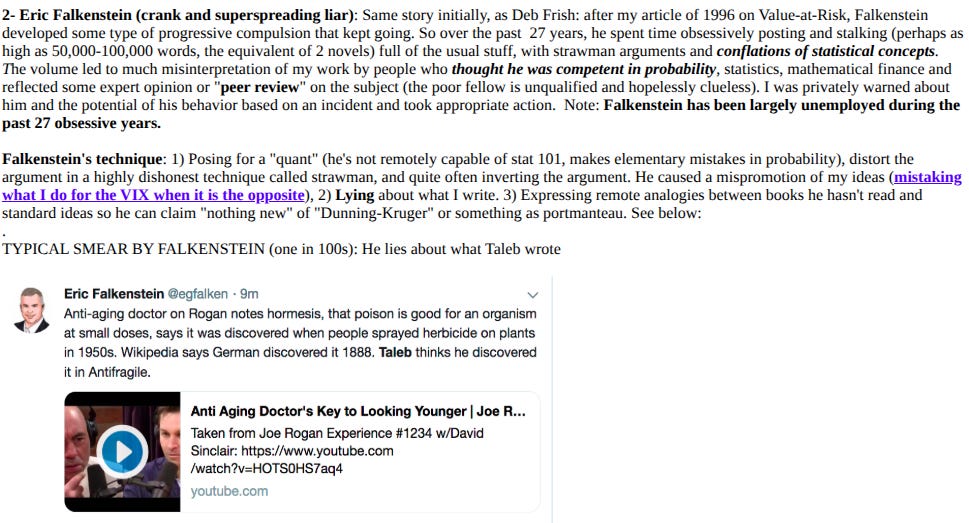
On any other thinker, this would be quite bad, but maybe salvageable. Insecure and irrational people can have good ideas; brilliant scientists go crazy. For Taleb’s books, it is absolutely damning.
Imagine you read a book that was all about ad hominem attacks and why they are, in fact, justified. It argues that it is better to trust people who are real professionals with skin in the game who are honorable and secure, and not to trust anyone who makes their living giving advice. Then you learn that the author of the book is incredibly thin-skinned, dishonorable, and volatile, and makes his living giving advice. By the author’s own logic, we shouldn’t trust anything they say! This is what reading Taleb is like.
If you want evidence of Taleb’s fragility, read A Tale of Two Talebs by Allen Farrington; it’s a better recap than I can offer. Taleb blocks and name-calls compulsively on Twitter, criticizes works he clearly has not read, brags about inventing the bitcoin lightning standard in the trading pits… the list goes on.
If you want arguments that you should judge the author, not his words… read Taleb himself! In Skin in the Game, Taleb is emphatic about this:
You cannot separate knowledge from contact with the ground. Actually, you cannot separate anything from contact with the ground. And the contact with the real world is done via skin in the game—having an exposure to the real world, and paying a price for its consequences, good or bad.
Intellectualism is the belief that one can separate an action from the results of such action, that one can separate theory from practice, and that one can always fix a complex system by hierarchical approaches, that is, in a (ceremonial) top-down manner. … Those who talk should do and only those who do should talk.
Verbal threats reveal nothing beyond weakness and unreliability. Remember, once again, no verbal threats.
You do not want to win an argument. You want to win.
It’s much the same in Antifragile:
People are cruel and unfair in the way they confer recognition, so it is best to stay out of that game. Stay robust to how others treat you.
Suckers try to win arguments, nonsuckers try to win.
There’s a long section in Skin in the Game about the Lindy effect, that those things which stand the test of time are expected to last even longer because they have been exposed to—and survived—real shocks. You are better off listening to your grandmother than some fancy-shmancy self-help guru. But Taleb got moderately wealthy by being a trader and a healthy dose of family inheritance (by his own admission), and now he… tweets, writes pop-economics books, and screams obscenities at people who criticize him. He does not look like a testament to antifragility. He has “won”, but largely in the domain of “talk.” Why not just read one of those classic novels Taleb claims to like so much?
In an earlier piece, I mentioned how reading Taleb was still quite a valuable “trigger” for me. I grew up in a pretty establishment-friendly environment and I did not understand risk very well. Taleb makes such aggressive claims that I was shocked into reconsidering a bunch of assumptions and reading more. I think there are some philosophical points which he gets right, and The Black Swan is still an interesting read. Furthermore, I don’t know of another book that introduces the same concepts and could serve as the same trigger in its place. Nate Silver’s On the Edge is the closest example, but it eschews more interesting statistical and epistemological points about risk for in-depth discussions of poker strategy. And I agree with Nassim that this is a terrible model for thinking about risk.
This makes me want to write a “no-bullshit” version of The Black Swan and antifragile: just the interesting parts, evaluated on their merits, without all the nastiness and obscurantism. If you would be interested in this, let me know!
The liars paradox strikes again. If NNT is reliable, you can’t trust him, but if you ignore his advice and evaluate his arguments the old fashion way on their own merits, a lot of them are good, but also imply that you shouldn’t trust them because of their source. Now, I’m wondering if looking at the way we resolve things like this in the real world might be helpful for resolving the paradox, although 99.99% certain that this approach would not work.
I like this