
You should offload (some) thinking!
How else do you expect to learn?

About a month ago, this note got a lot of likes:
Now, I’m a firm believer in independent learning. I quit high school classes to self-study from videos and textbooks, and it’s what landed me at Princeton. I have a friend who runs a graduate writing program; I’ve expressed to her several times that I think her department should blanket ban AI. And getting LLMs to do full end-to-end thinking for you is, right now, a disaster.
But I think this Schopenhauer quote is terrible reasoning. Why?
Because if it says using AI is bad for understanding, it also says READING BOOKS is bad for understanding! Look at the quote there! That’s what Schopenhauer is referencing. But clearly this would be terrible advice for people who want to learn. If I didn’t read the thoughts that other people had produced, I would never have learned calculus, logic, Shakespearean verse, neurobiology, rigorous argument, all of that wonderful stuff. That is what allows me to have all these interesting thoughts today! Andy Masley has argued the same:
Choosing to watch a movie is a massive outsourcing of thought. You could just close your eyes and imagine the whole thing in your head. There are so, so many mental tasks involved that you’re choosing to have someone else do for you:
Making up a story
Writing the music
Choosing the lighting, set, decorations, costumes, etc.
Have you ever seen someone watching a movie and thought “they’re so lazy for not just imagining a story?” If not, why? … The fact that other people have put in so much mental effort into so many parts of it opens up way more potential ways to think about it compared just making up a movie in your head, for the same reason a large complex economy has way more job opportunities than a simple small economy, even though in the large economy more work has “already been done.
But there’s more to the point than just what Andy says. Because theoretically, I could have sat around thinking of original ideas until I came up with the idea for Face/Off, and then done the rest of the work to make it happen, and then had all the same experiences. And I would have learned a lot.
But I could not have gotten the same value by sitting and thinking that I did from reading The Grapes of Wrath. Why? Because a lot of the value I got out of The Grapes of Wrath came from knowing it portrayed a real, awful time in history for real, desperate families. The very fact that someone else thought of it—didn’t even have to “think of it”, actually observed stuff like this!—gave it import and value.
A monkey banging on a keyboard for eternity would also eventually produce The Grapes of Wrath. They would even produce The Grapes of Wrath plus the sentence “This describes a real event that happened from 1929 to 1939, affecting millions of American farmers, raising employment to 30%, etc.” Like Borges’ library, this would still be useless to the monkey, because they would also write a million versions that said “This is all made up and fake”, and other versions that just said gibberish. There’d be no way of filtering what is valuable from what is garbage. Sure, learning to filter is part of the skill, but you can’t start from nothing—if you can’t tell value from garbage, then how can you be expected to know how to learn how to tell value from garbage?
A more concrete example: I am writing this just after midnight. I have Wittgenstein’s Blue Book open to my left, and Claude Desktop open on the right side of my laptop, to which I have uploaded a full .txt copy of the book. For the past hour, I have been slowly reading through the Blue Book, making notes, asking Claude questions, and revising my notes based on the feedback. And both Andy’s argument and mine apply here:
Asking these questions doesn’t reduce the level of thinking I do. It means I spend more time evaluating arguments, thinking of good questions, and trying to put new concepts into my own words than I would just trying to comprehend what’s being said. If I end up moving through the book faster, then I can read more books; I have thirteen I want to read just a few inches to my right.
I could write my own interpretation of Wittgenstein, for sure. But how would I know if I am interpreting what he actually meant? How do I make sure I am not misunderstanding the material? Sure, I could double-check, do close readings. But if the problem is that I misinterpreted Wittgenstein in the first place, then how am I going to be able to interpret him well enough to realize that my interpretation is wrong? I make my interpretation, then I ask Claude for help. Claude might not be good at doing original philosophy, but it’s great at factual recall and translating between different wordings to see if they match. In so doing, I get a corrective signal; I can filter out the value from the garbage. And by observing that happen, I start to learn how to filter better myself.
I do not just care about generating original thoughts. I also care about understanding what Wittgenstein actually had to say; that’s more ripe ground for future original thought than starting from scratch.
Of course, someone who only reads and memorizes and doesn’t do any thinking of their own isn’t likely to profit much other than entertainment, and the same goes from someone who only chats with the AI without doing original thinking. I doubt classmates who plug a PDF into ChatGPT and ask for reading responses are learning any more than folks who copy-paste from SparkNotes. But it doesn’t follow that the optimal level of AI use for learning is zero. Skepticism and prudence, not hostility, is what’s warranted.
Now, I suspect that most people who write notes like this aren’t thinking of people like me, doing careful reads and cross-checking with Claude to correct myself and revise. I’m probably nowhere near the majority of users. But if so, it saddens me that cheap cheating is the only use people can think of for technologies like Claude and ChatGPT. Why not be more creative, try something new?
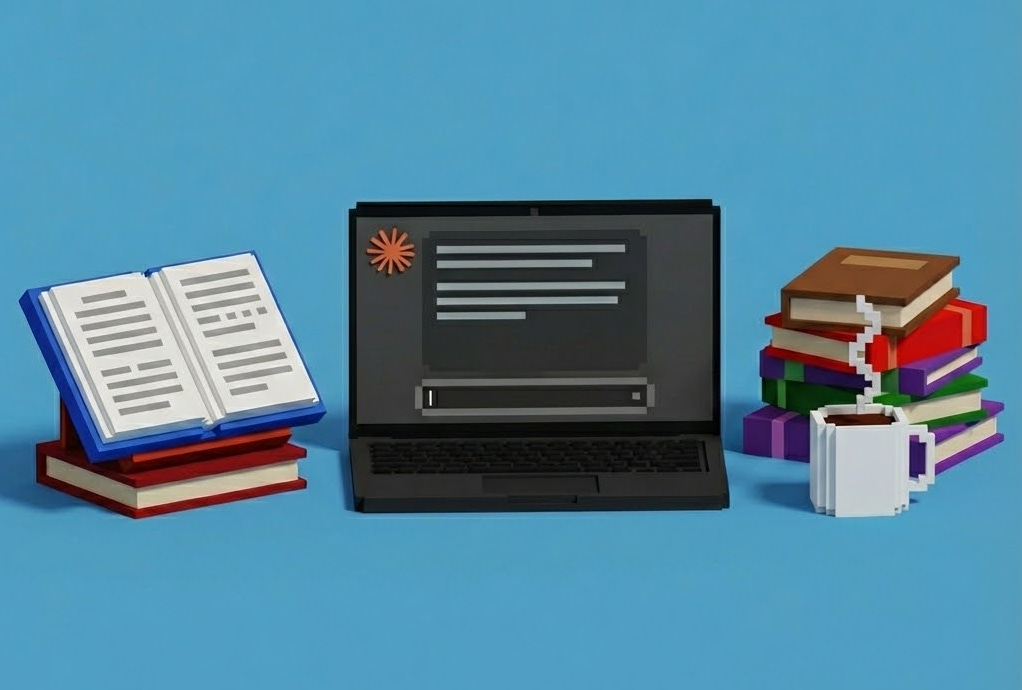
If you don’t already do this, I do encourage you to give it a shot. If you’re wary, pick a book or a field that isn’t that important to you yet, something you’re OK getting wrong if it turns out to be a bust. Grab a book and a bookstand and set it up on one side of your computer. Bring out paper and pencil. Find a PDF, .txt, EPUB, or other digital version of the book, and upload it to your LLM of choice (Claude is my favorite for this kind of thing). Work your way through, make your own notes, type in questions and clarifications, sip a mug of your favorite hot beverage. Is this really so awful? Does it really ruin the experience? Or is it a little—maybe imperfectly, maybe approximately—like having a human teacher by your side to help guide you through?