
Can brains suffer?
Maybe not!

One of the misconceptions about illusionism is that it denies the reality of conscious experiences. It is only meant to deny that conscious experiences have special metaphysical properties like privacy, ineffability, intrinsicness, etc. Mental states, like seeing red, feeling pain, and being sad, are still real. What are they, then? On the dominant account, these are functional states. That is, they are exhaustively defined by their causal relations to inputs, outputs, and other internal states.
So even on illusionism, I can still suffer. By that I mean I can have powerful, negatively valenced experiences like pain, terror, grief, rage, etc. I think gratuitous suffering is bad and should be avoided. If my fellow humans can suffer—and it really looks like they can—then I should avoid hurting them when it can be avoided. If animals can suffer—and it really looks like they can—then I should not pay to have them locked up, tortured, and slaughtered.
I agree with Keith Frankish that if illusionism is true, asking whether various intelligent systems are conscious is the wrong question. But I also agree with Frankish that asking whether, in what ways, and how much they can suffer is very important!
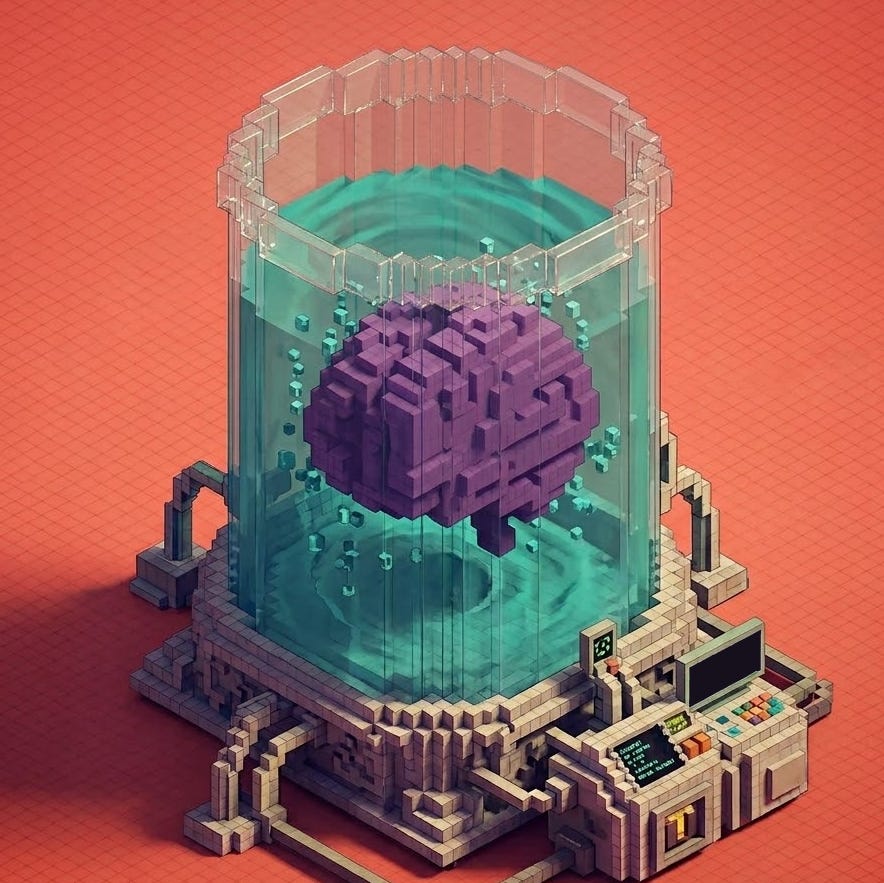
Now, consider a human brain-in-a-vat (BIV), with no motor outputs. Suppose we stimulate the brain just as we would if it were in a body and its left hand were being burned. The brain will behave just like a person’s brain would, shifting into fight-or-flight, activating the amygdala and periaqueductal grey, and triggering nerve impulses which would—if connected to a human body—trigger flinching away, self-reports of distress, nursing the wound, etc. However, none of these external responses actually occurs.
Whether this state can be called pain depends on your choice of definitions. You could call it pain, or pain, or shmain, I don’t care. What I want to know is: is the BIV having a horrible experience? Is it bad that it be in this state? Is it suffering? Unless you’re a moral anti-realist, these do not* seem like mere terminological questions. This isn’t even a particularly exotic edge case—scientists might be doing whole-brain emulations within the next century. If some kind of sentientist moral realism is true, there ought to be some kind of answer, and it seems quite important to figure out what it is!
One route is to just to deny that the BIV suffers at all. On a naïve externalist view, for a state to genuinely constitute suffering it must be grounded in some actual threat or loss to the organism, and/or must provoke some actual avoidance, destructive behavior, etc. This probably goes too far. We know phantom limb pain exists, where there is no actual tissue damage occurring, and we have all experienced mild pains which we do not actually take steps to alleviate, even if we would like them to go away.
On the other hand, if we adopt a naïve internalist view, then the stripping away of motor outputs shouldn’t matter at all because the internal structure of the brain is intact; all the state transitions and synaptic circuits are intact and acting just like they would in ordinary human pain. But then we might ask, what makes this state determinately an instance of suffering? This point requires a bit more fleshing out.
Imagine a Turing machine which accepts a string of 1s and 0s, and adds one 0 to the rightmost end. What function does this machine compute? One interpretation is that it computes doubling (n ⟼ 2n) on the natural numbers: if the string is interpreted as a binary encoding of a number, then adding a 0 shifts all the place values over and therefore multiplies by 2. But if the string is intepreted as reflected binary, then the relevant function is n ⟼ 2n + (n mod 2). Or maybe the string actually represents a walk in a binary tree (0 = go left, 1 = go right) and so the machine computes taking an additional left turn. Or… and so on. A Turing machine manipulates strings, and strings can be representations of numbers, but which representation is underdetermined, since there are an infinite family of functions which are structurally isomorphic to any particular operation. This is nothing novel: Bishop, Putnam, Chalmers, and Searle have all written about it in various forms. What makes the Turing machine a good example is that even without the messiness of a physical implementation, and even with all the counterfactual relations defined, there is still indeterminacy at the level of interpretation.
Similarly, if all that is required for suffering is some kind of state-transition system implemented in the brain, in virtue of what is that suffering? Sure, if you hook up that system to a human body, then it will result in avoidance, nursing the wound, verbalized agony, etc.—but you could also design a robot body where those nerve impulses are transduced a different way: a movement to flee becomes a movement to approach, a scream becomes a laugh, et cetera. The robots would say they are experiencing joy, the humans would say it is pain. Since the input/output relations are different, they are in different functional states. What would make the human-comparison right and the robot-comparison wrong? It seems again you need to rely on some external criteria: what was this brain state evolutionarily selected for, what does it typically mean within an actual population, which kind of organism cares about the results? Without some form of externalism, it seems like some kind of grand miracle, on par with psychophysical harmony, that the state which is internally an instance of suffering just happens to be the state which makes people say “hey, this feels really bad!”, since there are always a multiplicity of possible transduction systems.
Dispositional externalism suffers from the same problem. We might want to say that the BIV doesn’t actually flee from the pain source but it is disposed to do so. Well, disposed under what conditions? It will flee in the counterfactual where it has a human body and approach in the counterfactual where it has the robot body. Which set of counterfactuals is morally privileged, exactly?
You could turn to teleofunctionalism (this state belongs to a brain which through natural selection evolved to represent dangerous stimuli) or Lewis’ population theory (this state is a form of suffering in most of typical members of the species). Both of these suggest that Davidson’s Swampman, or a SwampBIV, would not suffer at all if you tortured him, since he has no evolutionary history. Are you willing to bite that bullet? It seems very counterintuitive to me!
Kammerer has argued along similar lines in his “argument from indeterminacy,” though his kind of indeterminacy is closer to what I’ve written about here, that our concept of consciousness is indeterminate in what it refers to.1 As an alternative, he proposes that we think about desires and aversions rather than consciousness. But it seems to me that whether the BIV has a desire is on similar grounds: under which counterfactuals, which interpretations, is it disposed to seek one thing or avoid another?
I don’t know! I feel quite uncertain here. Responses, either to resolve the puzzle, or to persuade me out of a premise (illusionism, moral realism, sentientism, moral determinacy) are welcome.
I feel like BIV is just an ill-defined concept to begin with? Like, in all animals with brains, the brain doesn’t just exist on its own. It’s connected to a whole nervous system, such that I don’t think it even makes sense to talk about a brain detached from the nervous system it’s integrated with. Maybe if you had an entire nervous system in a vat, this would be a more interesting question, and maybe we’d be closer to having answers.
(Note that I say this without any background in either neuroscience or philosophy of mind, so I may be completely wrong.)
The whole puzzle is generated by accepting the functionalist-mechanist framing and then discovering it can't determine which state is suffering, in effect deriving the indeterminacy from inside illusionism and treating it as a puzzle rather than a reductio. Suffering is not a functionalist/computational state.