
How I think about zombies

This is a slightly messier, more thought-dump essay than I’d normally write, but I haven’t published in a while and I felt like I needed to get something out there. Seeing this post, also about P-zombies, was the push I needed. Enjoy!
1. Are X and Y the same thing?
Welcome to Earth-2, where every square is blue.
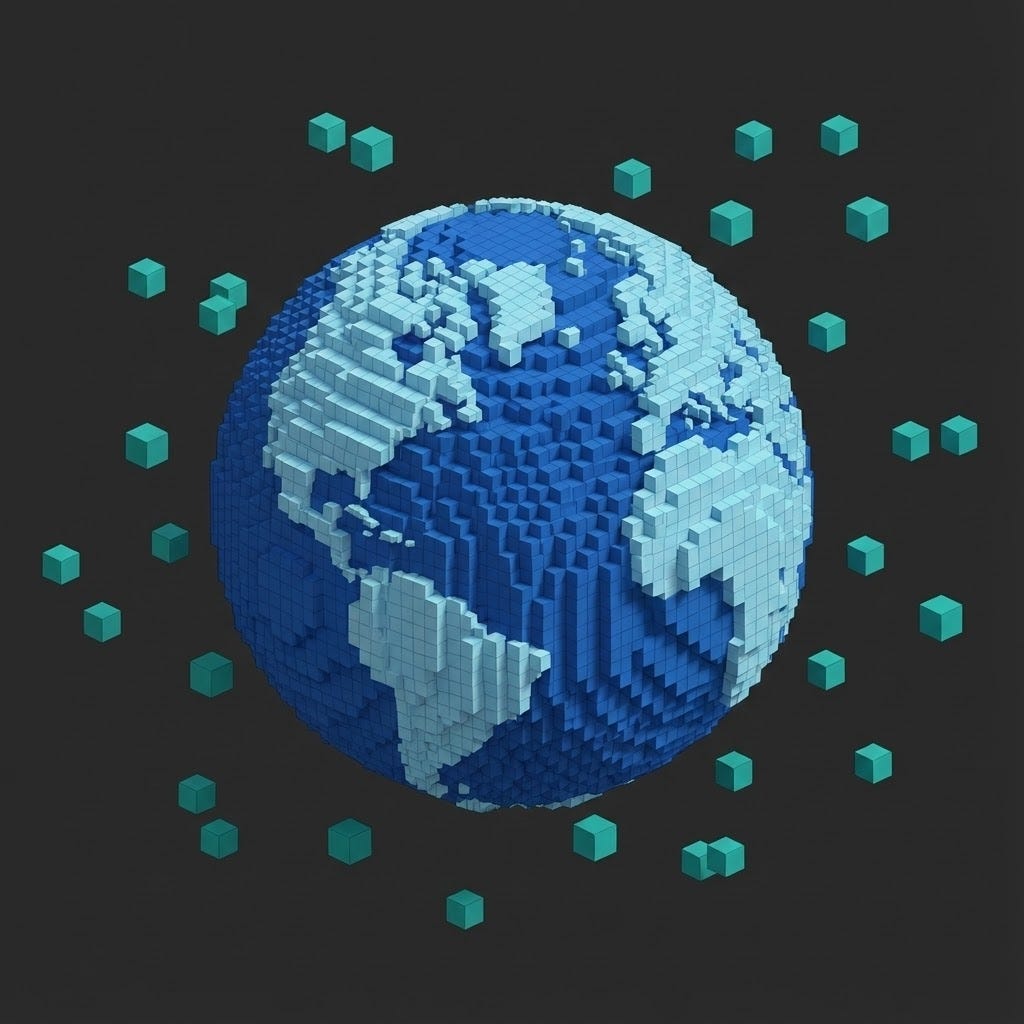
It is not just coincidental that every square is blue. In fact, it is a law of nature! Light behaves differently in this world such that whenever light would reflect to make a clearly demarcated square shape, the wavelengths interact to make blue light. In fact, this is the only way that the blue wavelength is created; without a square shape it destabilizes into other wavelengths. Yes, Earth-2 is a strange world—our physics don’t work anything like this!—but Earth-2 is logically possible.
One day, two inquisitive Earth-2 humans are arguing about reality. We catch them in media res:
ALEX: …just don’t see how you’re so hung up about this. Our scientists resolved this years ago. Blueness is an emergent property of squareness, we solved the connection between them. It’s not merely coincidental that all squares are blue—we worked out the exact laws of physics that make it so. You can’t construct a non-blue square; people have tried and failed! It’s impossible.
THEA: I’m not disputing that there is a law of nature that links squareness and blueness. I know it’s impossible for us to make a red square. But you can conceive of a red square, can’t you? It’s not a logical contradiction.
ALEX: You only think that because of folk physics, because you don’t understand how blueness and squareness are linked. The universe isn’t intuitive, it doesn’t have to make sense to you.
THEA: I know this is how it works in our world. All I’m saying is, there’s squareness—having four right angles and four sides. And there’s blueness—reflecting this wavelength. And we do know that squareness always causes blueness. My question is simply: are squareness and blueness the same thing? Or are they different things?
ALEX: What difference does it make where we draw the boundary? Our words are just ways of labeling physical phenomena. Are you one thing, or are you a pile of cells? Are Batman and Bruce Wayne the same thing? I don’t think we make any progress by playing word games.
THEA: But there is a difference, because… okay. Imagine a square, with no corners, and no sides, but it’s still a square. Could such a thing possibly exist? In any world, with any laws of physics?
ALEX: No. It’s contradictory. To be square is just to be a polygon with four corners and four sides.
THEA: Right! Right. Exactly. But squares also have other properties, like, “being a shape my little brother can draw,” or “being the shape of the mortarboard my mother wore to her college graduation”… or, “being blue.” Every actual square has these properties. Every square you or I could hypothetically create would have them too.
But the sentence “My mother wore a circular graduation cap and to be a square is just to be a polygon with four corners” is not internally contradictory. It’s false—my mom didn’t wear a circular cap—but not logically invalid. We can imagine an alternate history where it’s true, and that alternate history is internally consistent.
So this is what I want to know:
“My mother wore a circular cap and squares are 4-cornered polygons” is false but not contradictory.
“S is a square with no corners and squares are 4-cornered polygons” is contradictory.
“S is a red square and squares are 4-cornered polygons” doesn’t seem contradictory to me. I can conceive of a red square without finding any internal contradiction. So it seems to me that blueness and squareness are not the same thing.
2. Consciousness and the philosophical zombie
A philosophical zombie, according to philosopher of mind David Chalmers, is a person who is exactly physically identical to a normal, conscious human, and behaves exactly like they do, but has no conscious experience, nothing it is like to be them.
Is a philosophical zombie like a red square, or a square with no corners?
Chalmers thinks philosophical zombies (henceforth “P-zombies”) are like red squares for our Earth-2 friends. They don’t exist. We couldn’t create one if we tried. There are probably laws of physics that make them impossible for our world. But they are not internally contradictory beings, not in the way that a cornerless square is incoherent. To Chalmers, that is enough to demonstrate that consciousness and the physical processes that constitute our bodies and behaviors are not the same thing.
Others, like rival philosopher Daniel Dennett, think P-zombies are like cornerless squares. Maybe not as obvious. But “ZFC set theory is true and the Dirichlet function is Riemann-integrable” doesn’t seem obviously contradictory, and yet it is. Just the fact that you can imagine them both being true says more about the limits of your imagination to fully conceive of complex possibilities than it does about P-zombie coherence. Dennett things that consciousness and our physical processes really are the same thing.1
This is not how I understood the P-zombie argument when I first read it around age 16. I thought Chalmers was saying “a non-blue square is possible under these laws of physics” rather than “blueness and squareness are not the same thing.” And so I unfairly thought Chalmers was being dumb. I don’t know that I agree with him now, but I don’t think he’s being dumb. I don’t think it’s crazy to believe that consciousness and physical processes aren’t the same thing. And I think zombie-thinking can be quite useful, as long as you know the potential pitfalls.
I’m saying “the same thing”, because I think gets the message across without adding jargon, but it could be slightly misleading. Consider: “X is a polygon with four corners” and “X is a polygon with four sides” are logically equivalent; it’s impossible to have one without the other. But are they the same property, or two different ones?
I like this
Okay, now I’m completely confused because aren’t philosophical zombies, supposed to be micro physically identical to us. In what sense can they be micro physically identical if they are not even operating under the same laws of Physics?
Also, even taking this thought experiment on its own terms, isn’t this just another way of asking whether consciousness is identical to something physical? If you think that a heartbeat is the same thing as the physical movement of heart muscles then it’s internally contradictory to imagine somebody who is micro physically identical to you, but doesn’t have a heartbeat. Meanwhile, if you think that a heartbeat isn’t just something physical, it is not contradictory to imagine such a person, so this just seems to be a different way of asking the same question that doesn’t actually bring new light to the issue. Basically, you can’t answer the question of whether a philosophical zombie is self-contradictory without already answering the question of whether consciousness is something physical. In which case there is no point to imagining a philosophical zombie.